
From 01/11/2026, charging stations have their own time-of-use electricity tariff. The law does not require battery storage. Why we still include batteries and solar power in our investment model for Complex and Tier A DC fast-charging sites, and when not to install them.
Does a fast-charging station beside a national highway also need battery storage and solar power, or are they just extra cost? This article answers that question.
The article Scharge charger installation: the power behind a fast charger gave the answer: they are not mandatory. Solar power and storage are planned for sites with a suitable roof, layout and load profile. That answer still holds. In the documents we have checked, no regulation yet requires a charging station to have battery storage.
This article explains which load profiles make battery storage (BESS) and solar power a mandatory component in our investment model. “Mandatory” here is a planning criterion, not a legal requirement.
From 01/11/2026, charging stations have their own electricity tariff for the first time, divided by time window. The new peak window of 17:30–22:30 also starts to apply. The power sector has 90 days to reprogram meters; meters not yet reprogrammed are still billed under the old time windows (Clause 2, Article 5 of Circular 60/2025/TT-BCT).
The conclusion first: where we treat it as mandatory, and where it is not needed
We divide rest stops into four tiers: Complex, A, B and C. Tier C covers affiliate points, mainly with AC charging.
| Site tier | Battery storage and solar power | Main reason |
|---|---|---|
| Complex | Mandatory in the model | Several DC fast chargers running at the same time, a large peak load, a wide canopy. |
| Tier A | Mandatory in the model | DC fast charging along national highways and expressways; the evening load falls in peak hours. Grid connection capacity may be a constraint. |
| Tier B | Advisable, depending on load | Depends on DC charging volume and grid capacity. Solar power can come first, with space reserved for the battery. |
| Tier C (affiliate point) | Usually not needed | Low-power AC charging; the existing low-voltage grid is usually enough. |
The tier name alone is not enough to decide. At each site, we check three measurable conditions:
- Peak shaving. The expected simultaneous fast-charging power exceeds the power permitted at the connection point, and upgrading the transformer substation costs more or takes longer than installing a battery.
- Backup. The rest stop must keep its essential loads running when the grid goes down. The capacity needed equals the power of the essential loads multiplied by the number of hours they must be kept running.
- Time shifting. Each kWh of capacity discharged every evening creates a difference of about 719,500 VND a year at low voltage, and 609,400 VND above 1 kV (the calculation is in the example below). Dividing the battery system's all-in price per kWh by this figure gives a simple payback period in years, before the cost of capital, degradation and maintenance.
At Complex and Tier A sites, our approach is that the rest stop keeps its essential loads running when the grid goes down, so the second condition always applies. The first condition is checked during the grid survey. The third condition decides how large the battery is. At Tier B, a battery enters the plan when the first or the third condition is strong enough.
Some Complex or Tier A sites cannot host a battery safely. In that case, our approach is to recalculate the fast-charging power according to the grid power permitted, with load management. Essential loads use another backup source. A battery is not placed in an unsafe location just to meet the criterion.
How the new policies change the calculation
The table below includes only documents we have checked against their sources.
| Document | Effective | What it means for charging stations |
|---|---|---|
| Decision 14/2025/QĐ-TTg (29/05/2025), on the structure of the retail electricity tariff | EV charging tariff provisions from 01/11/2026 | For the first time, a separate tariff group for EV charging, set as a ratio of the average price. The ratios apply for 3 years from 01/11/2026. |
| Circular 60/2025/TT-BCT (02/12/2025), on implementing electricity prices | 02/12/2025; EV charging tariff and time windows from 01/11/2026 | Commercial charging stations must install a separate meter to be billed at the EV charging tariff (Clause 1, Article 10). This tariff has only three levels, by time window. |
| Decision 963/QĐ-BCT (22/04/2026), on power system time windows | 22/04/2026; applied to bills from 01/11/2026, with meters reprogrammed within 90 days | Peak 17:30–22:30, Monday to Saturday. Off-peak 0:00–6:00. Sundays have no peak period. |
| Decision 2892/QĐ-BCT (31/10/2026), on retail electricity prices | 01/11/2026 | The EV charging tariff is calculated on an average price of 2,159.9037 VND/kWh. According to the press, this level reflects a 2% reduction, decided by EVN in Decision 1305/QĐ-EVN of 30/10/2026. According to Notice 557/TB-VPCP, the reduction applies up to and including 31/03/2027. |
| Decree 58/2025/NĐ-CP (03/03/2025), amended by Decree 243/2026/NĐ-CP (26/06/2026), on renewable energy power | 03/03/2025; amendments from 26/06/2026 | If the installation qualifies as rooftop solar: self-generation and self-consumption with a low-voltage connection needs only a notification; surplus power may be sold up to 50%. Installing storage is encouraged. |
| QCVN 43:2024/BGTVT, on road rest areas (Circular 56/2024/TT-BGTVT) | 01/01/2025; rest areas announced before that date must complete their charging systems before 01/01/2027 (section 5.1) | An EV charging area is a minimum required facility. The electrical system must operate safely, continuously and stably. |
| QCVN 32:2026/BCT, on EV chargers and charging stations (Circular 61/2026/TT-BCT, 29/09/2026) | 01/07/2027, not yet in force | Also applies to charging stations at rest areas. The charging power of battery storage (if any) counts towards the supply power (section 3.5.1); equipment supplying power to battery storage is outside the scope of the regulation (section 1.1.5.2). |
Demand has changed too. According to the International Energy Agency (IEA, Global EV Outlook 2026), electric vehicles made up nearly 40% of new car sales in Vietnam in 2025. The IEA forecasts that this share could exceed 80% by 2035, or be close to 75% under the current policy scenario. This is a forecast, not a commitment.
The grid's peak hours coincide with the peak hours for charging
The table below shows the retail electricity tariff for EV charging set by the Ministry of Industry and Trade. It is not our charging price.
| Voltage level | Off-peak (0:00–6:00) | Normal | Peak (17:30–22:30, Monday–Saturday) |
|---|---|---|---|
| Up to 1 kV (low voltage) | 1,620 | 2,700 | 4,212 |
| Above 1 kV | 1,534 | 2,549 | 3,758 |
Unit: VND/kWh, excluding VAT, as of November 2026. Source: Decision 2892/QĐ-BCT, via the newspapers Sài Gòn Giải Phóng and Tiền Phong and the Cần Thơ City legal dissemination portal; consistent with the ratios in the appendix to Decision 14/2025/QĐ-TTg.
At low voltage, the peak price is 2.6 times the off-peak price; above 1 kV, about 2.45 times. Each kWh shifted from peak to off-peak carries a difference of about 2,600 VND (low voltage) or 2,200 VND (above 1 kV), before losses.
The 17:30–22:30 window coincides with dinner time, when people stopping to eat may plug in. We do not yet have measured data on charging sessions by hour in Vietnam to publish, so we calculate by scenario.
Solar output is strongest around midday, which falls in normal hours. The sun sets around the start of the peak window. So solar power alone cannot cut the peak-hour electricity bill. The battery is what shifts electricity from off-peak hours to the evening.
Prices are still subject to change. The 2% reduction applies only up to and including 31/03/2027. The ratio of the EV charging tariff to the average price applies for 3 years from 01/11/2026, and may be adjusted by ±2% (Clause 3, Article 2 of Decision 14/2025/QĐ-TTg). EVN proposes time-window adjustments before 15/12 each year. The ATB 2025 dataset (NREL, United States) assumes a battery life of about 15 years, much longer than these periods. So we calculate the difference as a ratio to the average price: at low voltage, each kWh shifted, after losses, carries a difference of about 107% of the average price. We also test scenarios in which the peak window moves, or the difference narrows after the third year.
A worked example by hand: shifting evening charging to the battery
The example below uses assumptions, not data from any of our sites. Site owners can substitute their own figures.
Assumptions
- 2 DC fast chargers of 160 kW, buying electricity at up to 1 kV.
- 600 kWh charged per day; 30% falls in peak hours, i.e. 180 kWh.
- The battery sits behind the EV charging meter and supplies only the chargers; it discharges 180 kWh every evening and recharges during 0:00–6:00.
- Round-trip efficiency of 85%, following the ATB 2025 assumption.
- 312 days with peak hours per year: 52 weeks times 6 days.
600 kWh/day is a busy scenario, not an average. With 2 chargers of 160 kW, that means a vehicle is plugged in about 22% of the time, if the power actually delivered is about 35% of rated power, as in the German data cited by the IEA. In Germany, across all types of public charging points, average utilisation time is about 8%. If charging were spread evenly across the hours, the share falling in the peak would be about 21%; we assume 30% because the peak coincides with dinner time.
Step by step
- Without a battery. 180 × 4,212 = 758,160 VND/day.
- With a battery. 180 ÷ 0.85 ≈ 211.76 kWh must be charged in off-peak hours: 211.76 × 1,620 ≈ 343,051 VND/day.
- Difference. 758,160 − 343,051 ≈ 415,100 VND/day; times 312 days, about 129.5 million VND/year, excluding VAT.
- Per kWh shifted. 4,212 − (1,620 ÷ 0.85) ≈ 2,306 VND; times 312 days, about 719,500 VND/year for each kWh of capacity.
- Above 1 kV. 3,758 − (1,534 ÷ 0.85) ≈ 1,953 VND/kWh, i.e. about 609,400 VND/year for each kWh of capacity; with 180 kWh/day, about 109.7 million VND/year.
Sensitivity to the share of charging that falls in the peak (assumptions, low voltage):
| Share falling in the peak | kWh shifted per day | Difference per year |
|---|---|---|
| About 21% (charging spread evenly across the hours) | 125 | About 89.9 million VND |
| 30% (base scenario) | 180 | About 129.5 million VND |
| 40% | 240 | About 172.7 million VND |
These figures do not deduct the battery's investment, replacement and maintenance costs, or the cost of capital. They do not account for capacity degradation, the battery's own consumption for cooling and standby, or the capacity reserved for backup. Nor do they account for evenings when the battery discharges less than assumed, Sundays, the tariff after 31/03/2027, or capacity charges.
The other side of the equation is the cost of the battery system. According to a BloombergNEF survey, the global average price of a turnkey storage system in 2025 was 117 USD/kWh, down 31% from 2024. We do not yet have a public source for the unit price of small systems installed at charging stations in Vietnam, and we do not publish financial data for individual sites. So the example stops at the electricity cost side.
The solar part
This is a separate example: a 100 kWp canopy covering the whole car park in Ho Chi Minh City, not just the two charging bays above. According to the Global Solar Atlas (World Bank, Solargis), the specific yield in Ho Chi Minh City is about 1,422 kWh/kWp/year at the optimal tilt angle, i.e. about 142,200 kWh/year, nearly 390 kWh/day. A charging canopy has a low tilt, shading and dust, so actual output is lower.
Each kWh of solar power has a different value, depending on where it goes:
- Used directly by the chargers during normal hours: it replaces 2,700 VND bought from the grid (low voltage).
- Charged into the battery: the battery can already be charged from the grid during 0:00–6:00 at 1,620 VND, so each kWh of solar power charged into the battery replaces only 1,620 VND.
- Sold as surplus, if selling is allowed: at the previous year's average market electricity price, subject to a ceiling. We have not yet seen an official figure applicable to 2026.
So our operating approach is to use solar power directly when the chargers have a midday load, while the battery charges from the grid in off-peak hours. Solar power charges the battery only when output exceeds the midday load, or during a prolonged grid outage. In that case, the solar roof is the only source that can recharge the battery for essential loads. That is why the two components go together at Complex and Tier A sites.
Four arguments and one possibility
1. Time-of-use electricity prices
The retail electricity tariff for EV charging has only three levels, by time window (appendix to Decision 14/2025/QĐ-TTg, section 3.2). Commercial charging stations must install a separate meter to be billed at this tariff (Clause 1, Article 10 of Circular 60/2025/TT-BCT). So charging stations pay for electricity by time window, and evening charging is the most expensive part. A battery is one direct way to shift that part. Another way is to set a higher charging price in the evening. This needs no battery, but long-distance drivers stopping for dinner usually cannot choose when to charge.
2. Grid capacity and the transformer substation
Fast charging needs high power for short periods. Upgrading the connection capacity and the transformer substation takes time and money, and the grid does not allow it everywhere. QCVN 32:2026/BCT, which takes effect on 01/07/2027, requires stations to have measures so that total power does not exceed the level permitted at the connection point (section 3.5.5). The first way is to lower charger power when many vehicles are plugged in at once; drivers wait longer. The second way is for the grid to supply the base and the battery to supply the peak. The regulation does not require either way.
QCVN 43:2024/BGTVT requires the electrical system of a rest area to operate safely, continuously and stably (section 2.1.4), but does not specify a solution. At fast-charging sites, we choose a battery as part of the answer to the word “continuously”. This regulation also sets a minimum of 10% of all parking spaces where vehicles can be arranged to charge; the number of chargers installed follows demand and each investment phase. See also the article why rest stops must be standardised nationwide.
3. Solar power on the charging-area canopy
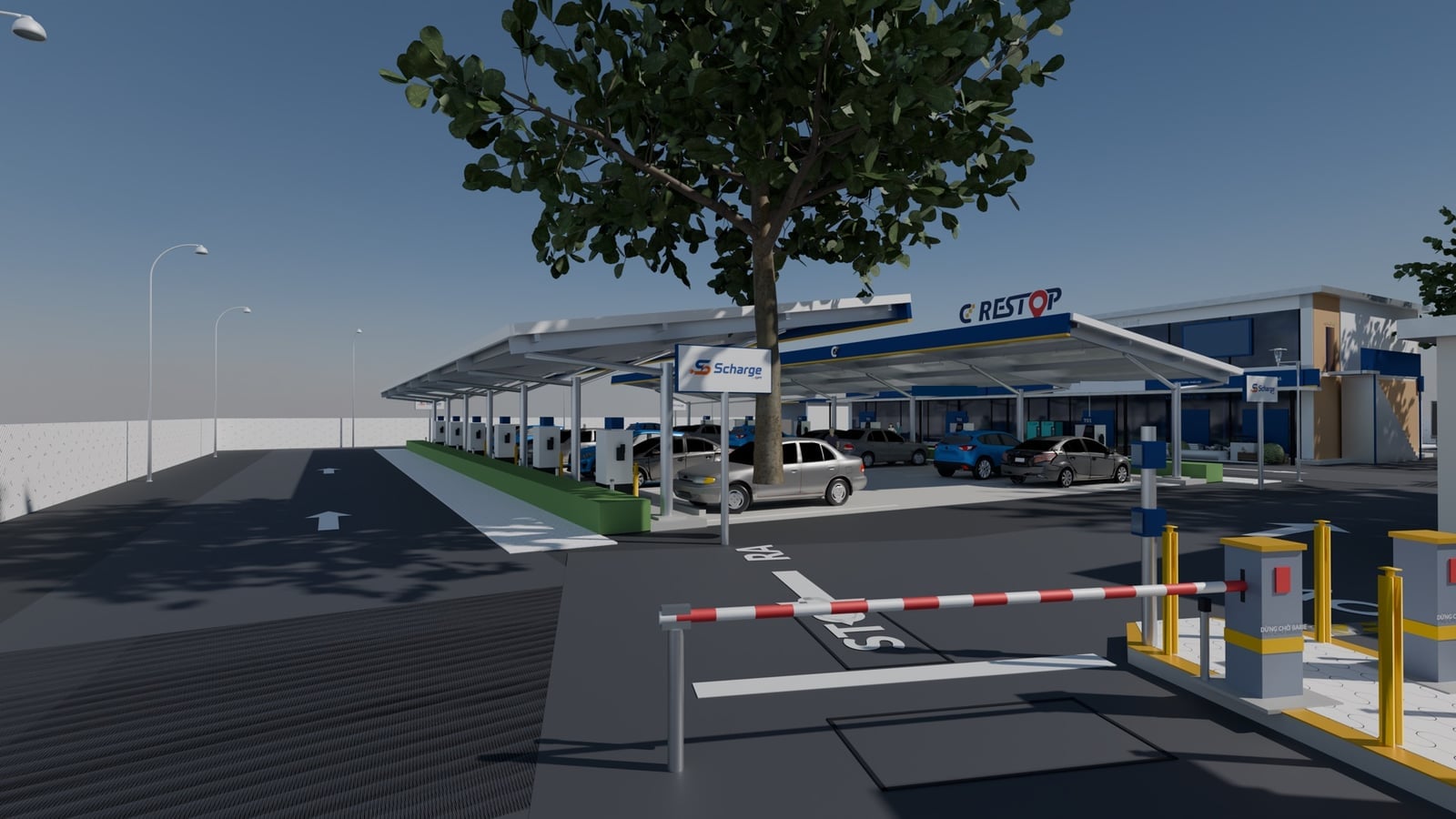
A charging area needs a canopy, and the canopy is a ready-made place to mount solar panels. Decree 58/2025/NĐ-CP, amended by Decree 243/2026/NĐ-CP, allows self-generation, self-consumption rooftop solar to connect to the grid, and encourages installing storage (Clause 2, Article 11).
The procedure depends on the connection level. Low voltage: send an online Notice to the commune-level People's Committee at least 10 working days before installation. Medium voltage and above, without selling surplus power: send a Notice to the provincial People's Committee, and install a device that switches reverse power flow on and off (Zero-Export), activated on instruction from the dispatch authority. Medium voltage and above, selling surplus power: a Development Registration Certificate issued by the provincial People's Committee is required before installation. Skipping the procedure is penalised under Article 7 of Decree 133/2026/NĐ-CP.
One point is unclear. The Decree defines rooftop solar as panels mounted on the roof of a structure “that is a building or has a building-like structure”. The text does not say clearly whether a charging-area canopy falls into this category. Our approach is to seek the regulator's opinion project by project, rather than interpret it ourselves.
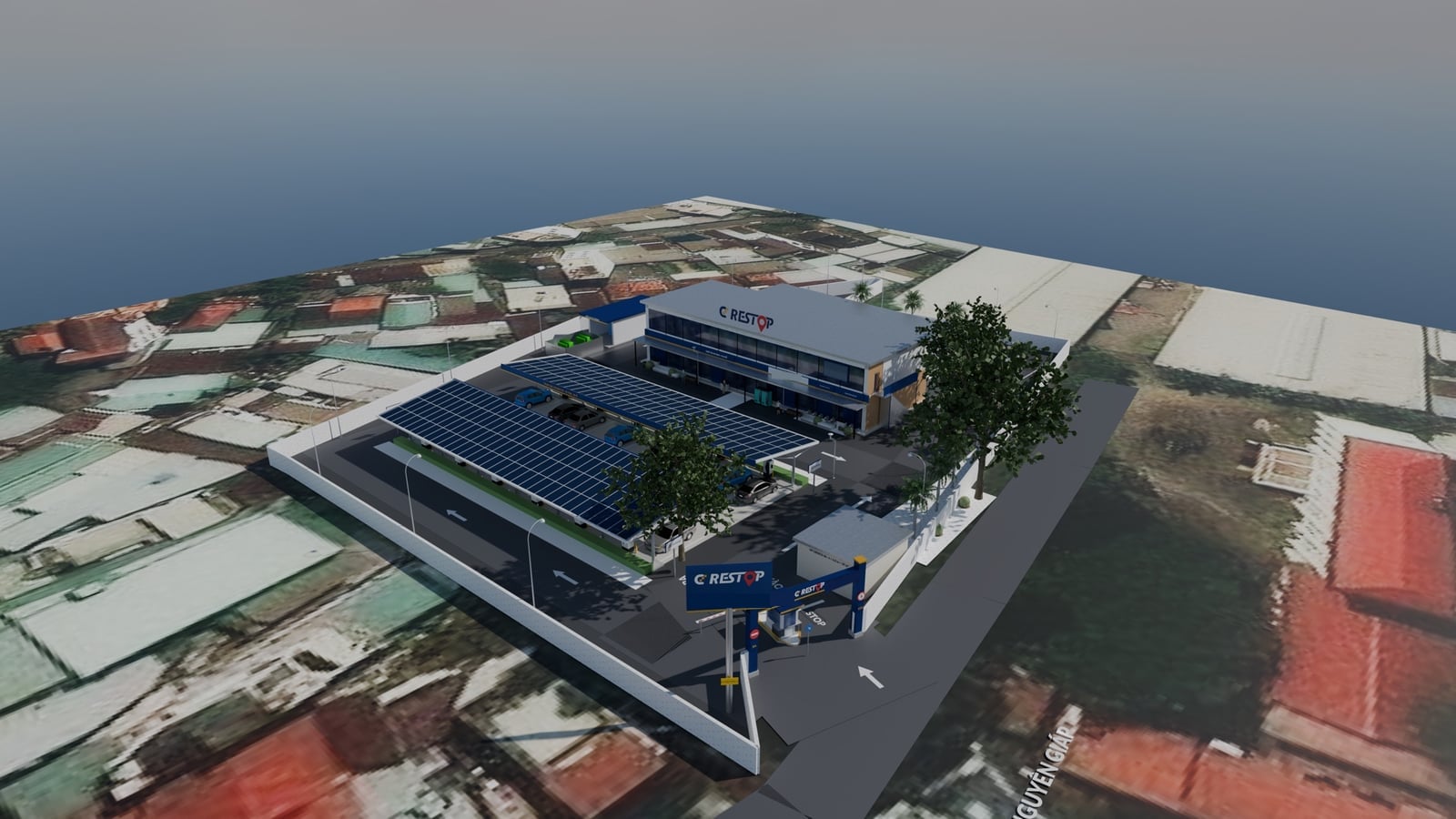
The rendering of CD Restop Suối Tiên, a Tier A site, shows a DC fast-charging station under a canopy fitted with solar power. This calculation is being included in the feasibility study. The project is in the planning stage; no chargers have been installed.
Who handles the energy part. In the Scharge Project, solar power and battery storage belong to Coro Energy, the existing joint-venture partner of DTH Holdings, which takes part according to the scope of each project. This system connects to the energy management and operations platform developed by DTH Holdings.
4. Social welfare: a rest stop that does not go dark when the grid goes down
When the grid goes down, a rest stop with no on-site source loses its car park lights, pumps and cameras. Battery storage, if designed for islanded operation from the start, keeps those loads running for a period of time. The IEA cites a model along the same lines, at a much larger scale. It is a heavy-duty truck charging station in China, operating since August 2025, with solar power on its canopy and a microgrid that can disconnect from the main grid.
One battery cannot do everything at once. If the battery discharges fully during peak hours, it is nearly empty by 22:30. By 2 a.m., under the example's assumptions, it has recharged only about one third. So our approach is to split the capacity into two parts. The time-shifting part discharges every evening. The backup part is not discharged during peak hours, and equals the power of the essential loads multiplied by the number of hours they must be kept running. This part creates no price difference. It is the cost of the term “social welfare”.
Electricity bought at the EV charging tariff is used only for the chargers (Clause 1, Article 10 of Circular 60/2025/TT-BCT). Lights, pumps, cameras and the staffed counter go through a different meter, at the business tariff. Our approach is to design the battery's connection and metering to keep these two parts clearly separate.
A backup generator can also keep these loads running. At fast-charging sites, we choose a battery because the same system also shifts load in time and shaves peaks, and needs no fuel stored on site. At sites where a battery cannot be placed safely, a generator remains the backup option. During an outage, the order of priority we are aiming for is lighting, water, security, the staffed counter, and only then vehicle charging at a limited level.
The possibility: two-part electricity pricing
Decision 14/2025/QĐ-TTg already provides a basis for multi-part retail electricity pricing (Clause 6, Article 3). Official Letter 7646/BCT-ĐL of 06/10/2025 from the Ministry of Industry and Trade allows EVN to pilot two-part pricing, made up of a capacity charge and an energy charge, with manufacturing customers using an average of 200,000 kWh/month or more. According to the Southern Power Corporation (EVNSPC), the pilot from the October 2025 billing period is calculated on paper only; customers do not pay at this price. A 2025 draft roadmap sets out a phase of actual payment with selected customers from July 2026 and expansion from August 2027. We have not seen a document approving this roadmap, and have not seen any plan to apply it to charging stations.
If capacity charges are based on the peak, each kW of peak that a battery shaves will carry a value. Our design approach is to be ready for that possibility, but not to add this benefit to the plan until there is a document. The site in the example uses about 18,000 kWh/month, less than one tenth of the pilot threshold.
When not to install
The list below decides whether to install at Tier B sites and Tier C affiliate points. At Complex and Tier A sites, it decides how much to install and when. The backup part for essential loads stays. The time-shifting part can be smaller, or deferred to a later phase, with space and cable routes reserved.
- Low evening charging volume. The price difference is proportional to the number of kWh shifted. The enclosure, the converter, fire protection, surveys and procedures do not shrink accordingly. With 30 kWh in the evening, the difference is only about 21.6 million VND/year, which makes it hard to recover the fixed costs. If actual charging volume is lower than forecast, the surplus capacity yields nothing.
- AC charging only. Tier C affiliate points provide low-power AC charging. The load usually does not reach the grid limit, and the peak price difference is usually not enough to offset the cost of a battery.
- The local grid has spare capacity. If the existing transformer substation is enough for the peak load, the case for peak shaving weakens.
- Unsuitable roof. The roof is shaded, the structure cannot take extra load, the area is small, or it is unclear whether it qualifies as rooftop solar.
- Fire safety conditions for the battery are not met. There is no place to put the battery away from crowded areas, no access for fire engines, or it can only be placed in an enclosed space. Our approach is not to install a battery in such locations.
- Short site tenure. The battery is assumed to last about 15 years, following ATB 2025. If the site tenure is much shorter, a relocation plan needs to be worked out, or the battery should not be installed.
If your site offers only AC charging, or very few kWh fall in the evening, you can stop here. The article Fast charging or full charging? Read the power ratings helps you choose the type of charger first. If you are not sure whether to invest yourself or cooperate, see Three Ways into Charging Infrastructure.
Risks and how we manage them
Fire safety for the battery. As of the date of writing, we have not found a national technical regulation on fire safety specifically for battery storage systems. Decree 58/2025/NĐ-CP requires fire safety to be ensured when installing a storage system (point h, Clause 2, Article 37). TCVN 14499:2025, equivalent to IEC 62933, has parts on safety but is a voluntary standard. Our approach is to use TCVN 14499 as the design reference. The battery is to be placed outdoors, away from the dining and rest areas. The battery system is to be included in the project's fire safety dossier from the design stage.
Battery degradation. Batteries gradually lose capacity over time. We do not state a specific number of cycles, because there is not yet an independent source beyond the manufacturers' figures.
No payment mechanism yet seen for customer-side storage. Article 4 of Decree 58/2025/NĐ-CP gives priority dispatch at peak hours to projects with storage, but excludes self-generation, self-consumption sources. The Electricity Law No. 61/2024/QH15 (as amended and supplemented) mentions financial support for rooftop solar and storage (Clause 2, Article 22). The Law assigns the Prime Minister and provincial People's Councils to issue this policy, but only for households. So we count only the benefits already set out in documents: the time-of-use price difference and self-consumed solar power.
Tariffs and regulations are still changing. We calculate plans under several price scenarios, and our approach is to design new sites to QCVN 32:2026/BCT from now on.
Frequently asked questions
The earlier article said it is not mandatory, and this one says it is. Which is right?
Both, for two different scopes. The article Scharge charger installation answers the general question: not every site has to install them, and current documents do not require it. This article covers only DC fast charging at Complex and Tier A sites. There, the battery and solar power are criteria in our investment model.
Does the power development plan require charging stations to have battery storage?
No, as of the date of writing. Decision 768/QĐ-TTg of 15/04/2025, adjusting Power Development Plan VIII, requires battery storage of at least 10% of capacity, with 2 hours of storage, but only for utility-scale solar power. This plan is being adjusted further; we will update if the requirement changes.
Can surplus solar power be sold to the grid?
Possibly, if the charging-area canopy is determined to qualify as rooftop solar; this is a point on which the regulator's opinion needs to be sought project by project. In that case, surplus power is sold by agreement, but not more than 50% of output. Up to and including 31/12/2030, a higher share may be agreed if the local grid can absorb it. If installed on a structure on land used for combined multiple purposes, at most 10% may be sold. The seller must hold an electricity operation licence, unless exempt. The purchase price is the average market electricity price of the immediately preceding year, subject to a ceiling.
What people on the road get
Two in the morning, on a quiet stretch of national highway, the grid goes down. At a rest stop with battery storage designed to run islanded, the car park lights stay on for as long as the battery allows. The toilets still have light and water. The cameras keep recording. The attendant is still at the counter. The long-distance driver still has a safe place to stop. That is what we are aiming for at Complex and Tier A sites. It is also why we set aside a separate share of capacity for backup, and treat battery storage as a mandatory component there.
Further reading: What Does a Good Charging Site Look Like and notes from the Ho Chi Minh City – Da Lat survey.
If you have a site beside a national highway or expressway and would like this calculation done for your site, please send information to hi@cdrestop.com or call 0981 107 900. We calculate from that site's own data, not from general figures.
See the charging station deployment process on the Scharge partnership page.